



You have completed your thesis. The research questions are answered, the data has been analysed, and the final document is ready. But there is another opportunity ahead: turning your research into a journal article that reaches a wider academic audience. For postgraduate scholars at Jomo Kenyatta University of Agriculture and Technology (JKUAT), journal selection should begin with the subject of the research. This is especially important for the School of Communication and Development Studies (SCDS), where academic work spans communication, media, development studies and linguistics.
JKUAT places the school within the College of Human Resource and Development (COHRED) and identifies the Department of Media Technology and Applied Communication, Department of Development Studies, and Centre for Foreign Languages and Linguistics within this academic area. So, where could such research find an appropriate publication home?IPR Journals and Books (IPRJB) offers several journals that correspond with these areas.
Which IPRJB Journal Matches Your Research?
The easiest starting point is your research topic. For media, public relations, digital communication, corporate communication and strategic communication, consider the International Journal of Communication and Public Relation. The journal covers communication theory, media studies, public relations, political communication, crisis communication, corporate communication, digital media and social media. For research on poverty, investment and development, the Journal of Poverty, Investment and Development offers a focused publication option. Meanwhile, broader studies on development challenges can be considered for the Journal of Developing Country Studies. If your study focuses on language, linguistics, multilingualism or sociolinguistics, the International Journal of Linguistics provides a specialised research audience.Research involving governance, public management, policy analysis or public service delivery can be considered for the Journal of Public Policy and Administration.
IPRJB Journal Options for SCDS Research
| Research Area | Suitable IPRJB Journal | Examples of Topics | Submission |
|---|---|---|---|
| Communication, Media & Public Relations | International Journal of Communication and Public Relation | Digital communication, social media, public relations, media studies, corporate communication, strategic communication | journals@iprjb.org |
| Poverty, Investment & Development | Journal of Poverty, Investment and Development | Poverty reduction, livelihoods, investment, inclusive growth, community development, sustainable development | journals@iprjb.org |
| Development Studies | Journal of Developing Country Studies | Development challenges, gender and development, education, health, culture, governance, social development | journals@iprjb.org |
| Language & Linguistics | International Journal of Linguistics | Linguistics, multilingualism, sociolinguistics, language acquisition, discourse, semantics, language education | journals@iprjb.org |
| Public Policy & Administration | Journal of Public Policy and Administration | Policy implementation, governance, public participation, public service delivery, public management, policy evaluation | journals@iprjb.org |
Turn the Thesis Into a Focused Article
A thesis contains extensive detail because it documents the entire research journey. A journal article needs a sharper story. Rather than submitting the dissertation as it stands, identify the main finding or research contribution you want readers to remember. Then build the article around the research problem, methodology, key findings and conclusion. For example, a dissertation may contain several objectives. A journal article can focus on one important relationship, finding or research question and present it in a concise format. This approach makes the manuscript easier to read and gives reviewers a clear understanding of its contribution.
What Does CUE Say About Publication?
Publication requirements matter when a journal article forms part of postgraduate study. The CUE Universities Standards and Guidelines, 2014 state that, before a doctoral degree is awarded, a candidate should normally show proof of acceptance for publication of at least two papers in refereed journals. CUE’s Draft Universities General Regulations and Schedules, 2026 proposes that a Master’s candidate should show proof of acceptance for publication of at least one paper in a refereed journal. The draft also proposes publication requirements involving scientifically indexed refereed journals for doctoral candidates. CUE Because the 2026 document is a draft, confirm the requirement that applies to your specific JKUAT programme before using a publication to meet a graduation condition. This simple check can save time: first understand your programme’s requirement, then select a journal that fits both the research topic and the academic requirement.
Why Do Refereed Journals Matter?
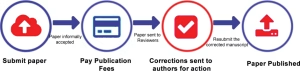
Peer review gives a manuscript an academic assessment before publication. The selected IPR Journals and Books titles describe peer-review processes for submitted work. For an author, this means the process can provide:
- Academic assessment before publication
- Feedback from reviewers
- An opportunity to improve the manuscript
- Editorial consideration before publication
- A structured route from submission to publication

What About Indexing and Research Visibility?
Once your article is published, readers need to find it. The selected IPR Journals and Books titles are listed across academic discovery and indexing services such as Google Scholar, EBSCOhost, Crossref, SCILIT, Dimensions, RePEc, ResearchGate and Academia, depending on the journal. These services can help increase the visibility and discoverability of published research. However, they serve different purposes
Why Publish With IPR Journals and Books?
Publishing can become an important part of your academic profile. With IPR Journals and Books, authors can benefit from several aspects of the publication process.
- Wider visibility: Online publication makes your findings accessible to readers beyond your university.
- A lasting research record: Your article becomes part of your documented scholarly output.
- DOI identification: IPRJB journals assign DOI identifiers to published articles, supporting citation and linking.
- Low publication fees and waivers for authors from low-income countries or with financial difficulties.
- Peer-review experience: Reviewer feedback can help strengthen your current manuscript and improve future papers.
- Subject-focused outlets: Instead of placing communication, development and linguistics studies in one broad category, IPRJB provides different journals for different research interests.
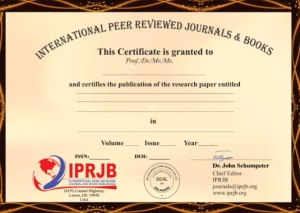
- Publication documentation: IPRJB journal information includes publication certificates and article details for published work.

Before You Submit
Before sending your manuscript to IPR Journals and Books, take a final look at five areas:
- Scope: Does the journal cover your research topic?
- Manuscript: Does the paper follow the journal’s author guidelines?
- Quality: Are the methodology, findings and references clear?
- Programme: Does the publication meet your JKUAT requirement?
- Indexing: If your programme specifies a database, have you verified it?
These checks help you submit to a journal that fits your study rather than choosing a title based only on its name.
Take Your Research Beyond the Thesis
The JKUAT School of Communication and Development Studies brings together research on communication, media, development, language and public affairs. That diversity calls for publication options that reflect the different subjects being studied. IPR Journals and Books provides several such options. The next step is straightforward: identify your research focus, check the journal scope, confirm your programme requirements and prepare your manuscript for submission.
Ready to Submit?
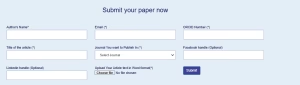

IPR Journals and Books: journals@iprjb.org
Submit Your Article to IPR Journals and Books
Your thesis records what you discovered. Your journal article gives those findings an opportunity to reach a wider academic audience.