
You have finished your research. You have collected your data, studied the results and written your paper. But before you click “Submit,” ask yourself one important question: Is your manuscript ready for peer review? At IPR Journals and Books, we encourage researchers to look beyond completing a paper and check whether the work is clear, complete and ready for review. A good study can still face problems when the research problem lacks focus, the methods need more explanation, or the findings do not answer the research questions. That is why manuscript preparation matters. At IPR Journals and Books, we see preparation as the process of turning completed research into a paper that editors and reviewers can understand and assess with ease.
What Does It Mean for a Manuscript to Be Ready for Peer Review?
A manuscript is ready when another researcher can read it and understand the study without asking the author to explain missing details. IPR Journals and Books recommends checking whether the research problem, objectives, methods, findings and conclusion form one clear story. In simple terms, manuscript preparation means getting your research ready for another academic to examine. The paper should use clear language, show good research methods and support its claims with evidence. IPR Journals and Books encourages authors to review the whole paper instead of focusing on one section at a time.
Is the Research Problem Clearly Explained?
A reviewer will want to know one thing from the start: What problem does this research address? At IPR Journals and Books, we recommend explaining the research problem early in the paper. Readers should not need to search through several pages to discover the main issue. During manuscript preparation, explain what is unknown, unclear or not working well. Then explain why the issue deserves study. For example, saying that “technology affects businesses” is too broad. A stronger paper might examine how a specific form of technology affects the performance of a certain group of businesses. IPR Journals and Books recommends using simple and direct language when stating the problem.
Does the Literature Review Show a Clear Research Gap?
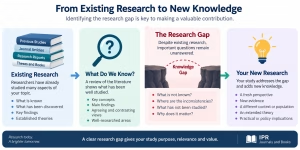
A literature review should do more than list previous studies. It should show what researchers already know and what they still need to understand. IPR Journals and Books encourages authors to use the literature review to build a clear case for their study. Good manuscript preparation means showing what earlier studies found, where they differ and what they did not examine. For example, many researchers may have studied a topic in developed countries, while very few have examined the same issue in Kenya. That difference could provide a useful research gap. IPR Journals and Books recommends making this link clear to the reader.
Are the Research Objectives and Questions Aligned?
Your objectives and research questions should guide the entire study. IPR Journals and Books recommends checking whether your methods, analysis, findings and conclusion all connect to the questions you raised at the beginning.
As part of manuscript preparation, use this simple test: Research question → Method → Finding → Conclusion
If these four parts do not connect, revise the paper before submission. For example, if your research question asks whether two factors have a relationship, your method should show how you will measure that relationship. IPR Journals and Books encourages authors to fix such gaps before peer review.
Is the Methodology Easy to Understand?
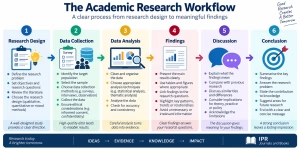
The methodology tells readers how you conducted the research. Reviewers often pay close attention to this section. IPR Journals and Books recommends explaining the research design, population, sample, sampling method, data collection process and data analysis approach. Good manuscript preparation should answer simple questions about your research process. Why did you choose this design? Who took part in the study? How did you select the sample? How did you collect the data? How did you analyze it? IPR Journals and Books encourages researchers to give reviewers enough information to judge these choices.
Do the Results Answer the Research Questions?
Your results should directly answer your research questions and objectives. IPR Journals and Books recommends checking each major finding against the objectives before you submit the paper. During manuscript preparation, remove findings that do not help answer the main research questions. Tables and figures should also have a clear purpose. Give each one a simple title, clear labels and a short explanation. IPR Journals and Books recommends avoiding tables that contain information the reader does not need.
Does the Discussion Explain Why the Findings Matter?
The results tell readers what you found. The discussion tells them what those findings mean. IPR Journals and Books recommends using this section to connect your findings with earlier research. Good manuscript preparation means more than repeating the results. Explain whether your findings agree with earlier studies or differ from them. Then explain possible reasons for the similarities or differences. IPR Journals and Books also recommends showing how the findings may help practice, policy, theory or future research.
Are Your Conclusions Supported by Your Findings?
A conclusion should bring the study together. It should not introduce major information that you never discussed earlier. IPR Journals and Books recommends checking whether every main conclusion comes directly from the findings. During manuscript preparation, ask whether your conclusion answers the original research problem. Avoid making claims that the evidence cannot support. IPR Journals and Books encourages researchers to keep their conclusions within the limits of their data and research design.
Have You Explained the Study’s Limitations?
Every study has limitations. This does not mean that the research has no value. Instead, it shows that the researcher understands the limits of the study. IPR Journals and Books encourages authors to discuss important limitations honestly. During manuscript preparation, consider factors such as sample size, location, data access, response rates and research design. Then explain how these factors may affect the findings. IPR Journals and Books recommends being open about limitations while also explaining the value of the research.
Are Your References Accurate and Complete?
Your references need careful attention before submission. IPR Journals and Books recommends checking every citation and reference in the paper. Good manuscript preparation means making sure that every source cited in the text appears in the reference list. Check the author’s name, publication year, article title and other details as well. Follow the referencing style required by the journal. IPR Journals and Books also recommends checking references created by software because automated tools can make mistakes.
Have You Addressed Research Ethics?
Research quality also depends on ethical conduct. IPR Journals and Books encourages researchers to address issues such as informed consent, confidentiality, ethical approval, conflicts of interest and funding where they apply. Responsible manuscript preparation also means giving proper credit to other researchers. Check your paper for plagiarism, copied material and inappropriate reuse of earlier work. IPR Journals and Books encourages authors to protect the honesty and originality of their research throughout the publishing process.
Does Your Manuscript Follow the Journal’s Guidelines?
Before you submit, check the requirements of your chosen journal. Journals may have different rules for word count, structure, references, tables and figures. IPR Journals and Books recommends checking these requirements before you finish the final version. This final stage of manuscript preparation can prevent simple errors. Check the headings, page layout, spelling, grammar, citations, tables, figures and references. IPR Journals and Books recommends reviewing the paper as one complete document.
How Can You Test Your Manuscript Before Submission?
Try reading your paper like a reviewer. Can you find the research problem quickly? Can you see the research gap? Does the method answer the research questions? Do the results support the conclusion? IPR Journals and Books recommends this simple test before submission. You can also ask a colleague or supervisor to read the paper. A fresh reader may spot unclear ideas or missing information that you have overlooked. During manuscript preparation, outside feedback can help you improve the paper before a reviewer sees it. IPR Journals and Books encourages researchers to use this opportunity whenever possible.
What Should You Check Before Clicking “Submit”?
Before you submit your research, IPR Journals and Books recommends checking these points:
- Is the research problem clear?
- Is the research gap well explained?
- Are the objectives and research questions clear?
- Does the method answer the research questions?
- Do the findings answer the questions?
- Does the discussion explain the findings?
- Are the conclusions supported?
- Are the references complete and accurate?
- Have you addressed relevant ethical issues?
- Are the tables and figures clear?
- Does the paper follow the journal guidelines?
- Have you proofread the complete paper?
This final manuscript preparation check can help you catch simple problems before submission. More importantly, IPR Journals and Books reminds authors that peer review tests the quality and value of research, not just the appearance of the paper.
Final Thoughts: When Should You Submit Your Manuscript?
Finishing a research paper does not always mean that it is ready for peer review. IPR Journals and Books encourages researchers to take one final look at the paper and ask whether the research problem is clear, the methods make sense, the findings have support and the contribution is easy to understand. Effective manuscript preparation gives good research a stronger chance to make a clear impression on editors and reviewers. Therefore, do not submit simply because the paper is finished. IPR Journals and Books encourages researchers to submit when the manuscript is clear, complete and ready to be reviewed.
Ready to take your research to the next stage? Explore the publishing opportunities and academic resources available through IPR Journals and Books, and give your research the professional presentation it deserves.